
2014 · Twelve-movement work for soloists, choir and ensemble
Magnificat
A substantial setting of Mary’s song in which the familiar canticle is placed alongside texts from Christian, Jewish and Islamic traditions.
c.55 minutes · solo SATB quartet · SATB chorus · strings and piano · optional harp and percussion
Listen
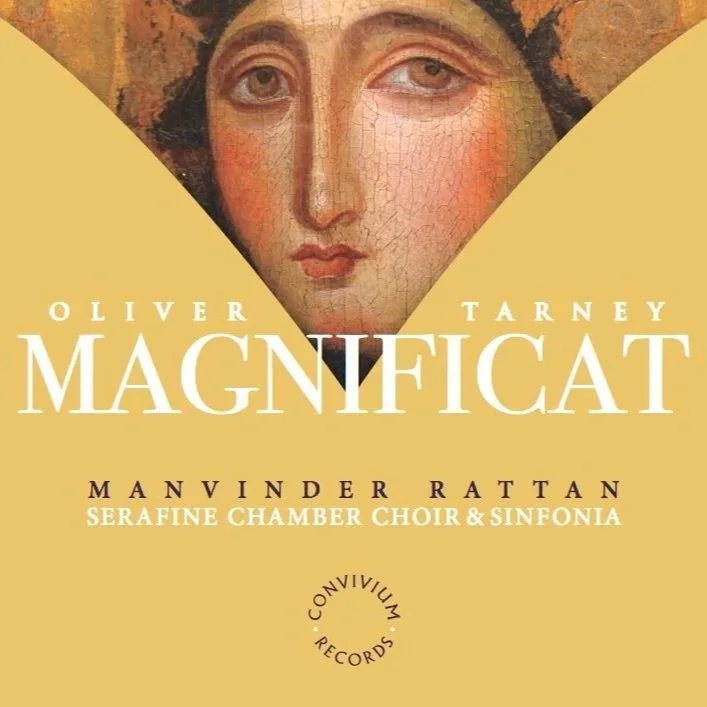
The première recording is performed by Serafine Chamber Choir & Sinfonia, with Katy Thomson, Claire Tasker, Paul Bentley-Angell and Tom Herring, conducted by Manvinder Rattan.
For a first listen, try Et misericordia: one of the more reflective movements and a straightforward way into the sound-world of the work.
Serafine Chamber Choir & Sinfonia · Manvinder Rattan · Convivium Records
Explore the music
Three shorter works offer further routes into the choral sound and storytelling found in Magnificat.
For conductors
A complete concert work
At around fifty-five minutes, Magnificat has the scale to form the centre of a programme in its own right.
A wider view of a familiar story
The traditional canticle is placed within Christian, Jewish and Islamic texts, giving Mary’s story a broader dramatic and human context.
Colour without a full orchestra
Strings and piano form the core ensemble, with harp and percussion available where forces and venue allow.
Performing Magnificat
A perusal score is available online. Vocal scores and performance materials are available by hire; please get in touch for availability, costs or to discuss the forces needed for a performance.
More about Magnificat
Background, practical information, performances and reviews are available below if you would like to explore the work in more detail.
About the work
Magnificat places Mary’s song within a wider sequence of texts drawn from the Gospel of Luke, the Song of Hannah, the Infancy Gospel of James and the Qur’anic Book of Maryam.
Rather than treating the canticle simply as an outburst of celebration, the work considers the story from several perspectives: Mary as a young woman confronted by extraordinary news, the wider religious traditions that share her story, and the distance between private reflection and public proclamation.
Across twelve movements the music moves between intimacy and large-scale choral writing, with solo voices often bringing the listener close to individual characters before the full ensemble opens the perspective out again.
Commissioned by Manvinder Rattan and Sing for Pleasure for the organisation’s Golden Jubilee, the work was first performed at Keele University in 2014.
Practical information & programme note
- Structure
- Twelve movements, conceived as a continuous large-scale concert work.
- Soloists
- SATB solo quartet.
- Choir
- SATB chorus. The perusal score gives exact ranges, divisi and movement-by-movement requirements.
- Accompaniment
- Strings and piano, with optional harp and percussion.
- Materials
- A perusal score is available online. Vocal and instrumental performance materials are available by hire.
- Programming
- Suited to choral societies, university choirs and festival programmes looking for a substantial contemporary sacred work.
Selected performances
Complete work
Recording
Reviews
“Large scale, multi-textual, multi-layered Magnificat which dazzles with its seductive textures.”
“This is sublime music… a profound and beautiful spiritual journey in sound.”
Will Todd
The Quarterly Review described the work as “highly accessible” and praised its “private, reflective, mysterious moments” for reaching “a true depth of feeling”. Read the review →
Considering a performance?
I’d be delighted to hear from you if you are considering Magnificat, or if you would like to discuss programming, forces, performance materials or hire.